Paste a list of gene identifiers and get every gene back with links to the resources below, for 170 genomes. Nothing about your searches is saved.
Model organism databases appear on the genomes they cover:
 MGI
MGI RGD
RGD ZFIN
ZFIN Xenbase
 FlyBase
 WormBase
 SGD
SGD EcoCyc
 TAIR
TAIR PomBase
 dictyBase
 PlasmoDB
 TriTrypDB
 VectorBase
 Sol Genomics
 SalmoBase
 Gramene
 CGD
CGD FungiDB
 ToxoDBWormBase ParaSite
 CryptoDB
 TrichDB
 AmoebaDB
 GiardiaDB
 Pseudomonas Genome DB
 Mycobrowser
 AureoWiki
 KEGG
KEGG HymenopteraMine
 FAANGMine
 Animal QTLdb
 OMIA
OMIA Sheep Atlas
 Mousephenotype
The VEuPathDB sites — VectorBase, FungiDB, PlasmoDB, TriTrypDB, ToxoDB, CryptoDB, TrichDB, AmoebaDB and GiardiaDB — now ask for a free account before they will show a gene page.
Type or paste identifiers into the Input panel, one per line, then press Update. The Example button below the box fills it with up to ten random protein-coding genes if you would like something to try.
You can search by:
Anything typed into Search Addition is added to the PubMed, Google Scholar and OpenAlex searches. Entering TP53 with cancer alongside it links to the literature for both together.
The species picker takes either name — rat and Rattus norvegicus are the same genome — and the filter box matches on common name, scientific name or assembly. Most gene annotations come from Ensembl BioMart; the bacteria, viruses and cotton come from Ensembl Bacteria and NCBI instead, as Data quality sets out. Each genome names the assembly its coordinates are on.
The list is also published at /genomes.json, which is what the R and Python packages read.
Each gene comes back as a panel of links. Expand one with the on its right to see everything above for that gene, and collapse it again with the . A resource with no identifier for that gene is shown in red rather than left out, so the columns stay in the same order for every gene.
The menu at the top right of the results panel () will download the list as a CSV of symbols and Ensembl, Entrez and UniProt identifiers, build a printable PDF report, or send the whole list on to Reactome, g:Profiler, GeneMANIA, Complex Portal or Perplexity AI.
Both packages take a vector or list of identifiers and open it here.
A search is a URL, so a list can be linked to directly, with an optional genome and search term:
https://www.gene-list.com/search/TRP53,KRAS,KIT?genome=mouse&search_term=Cancer
Every count below is generated from the same database a search reads, September 2026 snapshot. Per-genome numbers, assemblies and the files themselves are on the Downloads page.

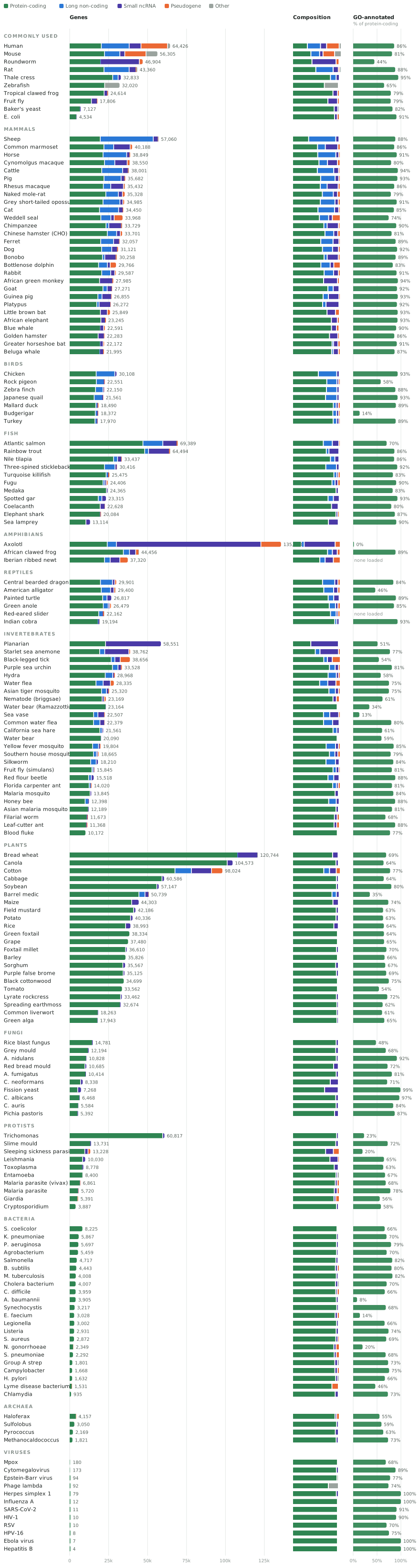
Gene records are retrieved per genome from Ensembl BioMart — the main mart for the vertebrates, the division marts for plants, metazoa, fungi and protists — or, for most of the bacteria and viruses and a few eukaryotes, from Ensembl Bacteria and NCBI, whose annotations carry the locus tags their communities use. That is RefSeq, except where RefSeq has renamed those tags and the GenBank annotation keeps them. Gene Ontology annotations come from the combined per-organism GMT files published by g:Profiler where its files match the genome version here; the rest load theirs from Ensembl BioMart or from UniProt's GO annotations, and E. coli's come from the GO Consortium's EcoCyc release. Across the 170 genomes that is close to 4.0 million gene records and 66 million GO annotations over more than 32,000 terms. The assembly each genome's coordinates refer to is named on the Downloads page.
Two things are worth knowing about what those records contain. Just under half carry no description, because most sources write one only for the genes they have curated: human, mouse and the other model organisms are close to complete, while nearly every wheat and rice record has none. Where a genome's own source publishes no description for any of its genes, the protein name from UniProt stands in — Chlamydomonas reinhardtii had none at all and now has one on 96% of its records. And where a source publishes no gene symbol, which is the majority of records in 98 of the genomes, the identifier is the display label; for fourteen of those genomes the community names that do exist are loaded as synonyms, so the gene answers to both.
Four rules are applied on import:
Currency and reproducibility. This is a snapshot rather than a mirror. Each genome reflects the source release current at the time it was imported — an Ensembl release for most, an NCBI assembly for the bacteria, viruses and cotton; releases are not pinned, and the genomes were not all imported together, so the collection is not a single coherent release. Identifiers are retired and reassigned between releases, so a list resolved here today may resolve differently later. For work that must be reproducible, take the gene table and GMT for the genomes you used and keep them with the result; for work that must be current, go to the sources named above directly. Either way the primary sources are the ones to cite.
Coverage. All but 2 of the 170 genomes have GO annotations loaded: Red-eared slider and Iberian ribbed newt have none, because what their sources publish is too sparse to key against the gene table — the ribbed newt has 137,856 UniProt entries and a gene name on 197 of them. Most come from g:Profiler's per-organism files; where g:Profiler does not cover an organism, or builds its file on a different genome version, the annotations come from Ensembl BioMart, from UniProt's GO annotations (the viruses, the bacteria other than E. coli, and cotton), or from the GO Consortium's EcoCyc release (E. coli). Annotation depth follows those files rather than any re-derivation here, so the semantics of a term's gene set are the source's. Not every resource covers every species, and one that covers a species may hold nothing for a particular gene: a red cell on a gene panel means the identifier that resource needs is absent for that gene, not that the gene is uncharacterised.
Please review the Terms of Use before using GeneList. Backgrounds are from Toptal.
GeneList is free to use. If you find it helpful, you can support its continued development on Ko-fi.
Support on Ko-fi→Alliance of Genome Resources Consortium. Updates to the Alliance of Genome Resources central infrastructure. Genetics 227, iyae049 (2024).
Alvarez-Jarreta, J. et al. VEuPathDB: the eukaryotic pathogen, vector and host bioinformatics resource center in 2023. Nucleic Acids Res. 52, D808-D816 (2024).
Amberger, J. S. et al. OMIM.org: leveraging knowledge across phenotype-gene relationships. Nucleic Acids Res. 47, D1038-D1043 (2019).
Ashburner, M. et al. Gene ontology: tool for the unification of biology. Nat. Genet. 25, 25-29 (2000).
Aurrecoechea, C. et al. AmoebaDB and MicrosporidiaDB: functional genomic resources for Amoebozoa and Microsporidia species. Nucleic Acids Res. 39, D612-D619 (2011).
Aurrecoechea, C. et al. GiardiaDB and TrichDB: integrated genomic resources for the eukaryotic protist pathogens Giardia lamblia and Trichomonas vaginalis. Nucleic Acids Res. 37, D526-D530 (2009).
Baldarelli, R. M. et al. Mouse Genome Informatics: an integrated knowledgebase system for the laboratory mouse. Genetics 227, iyae031 (2024).
Balu, S. et al. Complex portal 2025: predicted human complexes and enhanced visualisation tools for the comparison of orthologous and paralogous complexes. Nucleic Acids Res. 53, D644-D650 (2025).
Basenko, E. Y. et al. What is new in FungiDB: a web-based bioinformatics platform for omics-scale data analysis for fungal and oomycete species. Genetics 227, iyae035 (2024).
Belinky, F. et al. PathCards: multi-source consolidation of human biological pathways. Database J. Biol. Databases Curation 2015, bav006 (2015).
Berman, H. M. et al. The Protein Data Bank. Nucleic Acids Res. 28, 235-242 (2000).
Bertoni, D. et al. AlphaFold Protein Structure Database 2025: a redesigned interface and updated structural coverage. Nucleic Acids Res. 54, D358-D362 (2026).
Blum, M. et al. InterPro: the protein sequence classification resource in 2025. Nucleic Acids Res. 53, D444-D456 (2025).
Bradford, Y. M. et al. Zebrafish information network, the knowledgebase for Danio rerio research. Genetics 220, iyac016 (2022).
Buniello, A. et al. Open Targets Platform: facilitating therapeutic hypotheses building in drug discovery. Nucleic Acids Res. 53, D1467-D1475 (2025).
Cannon, M. et al. DGIdb 5.0: rebuilding the drug-gene interaction database for precision medicine and drug discovery platforms. Nucleic Acids Res. 52, D1227-D1235 (2024).
Carbon, S. et al. AmiGO: online access to ontology and annotation data. Bioinformatics 25, 288-289 (2009).
Carme, P. et al. PomBase in 2026: expanding knowledge, modeling connections. Genetics 232, iyag001 (2026).
Casper, J. et al. The UCSC Genome Browser database: 2026 update. Nucleic Acids Res. 54, D1331-D1335 (2026).
Cerami, E. et al. The cBio cancer genomics portal: an open platform for exploring multidimensional cancer genomics data. Cancer Discov. 2, 401-404 (2012).
Cerezo, M. et al. The NHGRI-EBI GWAS Catalog: standards for reusability, sustainability and diversity. Nucleic Acids Res. 53, D998-D1005 (2025).
Chen, S. et al. A genomic mutational constraint map using variation in 76,156 human genomes. Nature 625, 92-100 (2024).
Chu, S. et al. Xenbase: 25 years of integrating molecular and biomedical data from Xenopus. Genetics 232, iyaf237 (2026).
Clark, E. L. et al. A high resolution atlas of gene expression in the domestic sheep (Ovis aries). PLoS Genet. 13, e1006997 (2017).
ClinGen Consortium. The Clinical Genome Resource (ClinGen): Advancing genomic knowledge through global curation. Genet. Med. 27, 101228 (2025).
de Bruijn, I. et al. Analysis and Visualization of Longitudinal Genomic and Clinical Data from the AACR Project GENIE Biopharma Collaborative in cBioPortal. Cancer Res. 83, 3861-3867 (2023).
Del Toro, N. et al. The IntAct database: efficient access to fine-grained molecular interaction data. Nucleic Acids Res. 50, D648-D653 (2022).
Engel, S. R. et al. Saccharomyces Genome Database: advances in genome annotation, expanded biochemical pathways, and other key enhancements. Genetics 229, iyae185 (2025).
Fernandez-Pozo, N. et al. The Sol Genomics Network (SGN)--from genotype to phenotype to breeding. Nucleic Acids Res. 43, D1036-D1041 (2015).
Fey, P. et al. dictyBase and the Dicty Stock Center (version 2.0) - a progress report. Int. J. Dev. Biol. 63, 563-572 (2019).
Franz, M. et al. GeneMANIA update 2018. Nucleic Acids Res. 46, W60-W64 (2018).
Fuchs, S. et al. AureoWiki - The repository of the Staphylococcus aureus research and annotation community. Int. J. Med. Microbiol. 308, 558-568 (2018).
Gao, J. et al. Integrative analysis of complex cancer genomics and clinical profiles using the cBioPortal. Sci. Signal. 6, pl1 (2013).
Gargano, M. A. et al. The Human Phenotype Ontology in 2024: phenotypes around the world. Nucleic Acids Res. 52, D1333-D1346 (2024).
Gene Ontology Consortium. The Gene Ontology knowledgebase in 2026. Nucleic Acids Res. 54, D1779-D1792 (2026).
GTEx Consortium. The GTEx Consortium atlas of genetic regulatory effects across human tissues. Science 369, 1318-1330 (2020).
Heath, A. P. et al. The NCI Genomic Data Commons. Nat. Genet. 53, 257-262 (2021).
Hu, Z.-L. et al. Bringing the Animal QTLdb and CorrDB into the future: meeting new challenges and providing updated services. Nucleic Acids Res. 50, D956-D961 (2022).
Huttlin, E. L. et al. Dual proteome-scale networks reveal cell-specific remodeling of the human interactome. Cell 184, 3022-3040 (2021).
Jumper, J. et al. Highly accurate protein structure prediction with AlphaFold. Nature 596, 583-589 (2021).
Kanehisa, M. et al. KEGG: biological systems database as a model of the real world. Nucleic Acids Res. 53, D672-D677 (2025).
Kapopoulou, A. et al. The MycoBrowser portal: a comprehensive and manually annotated resource for mycobacterial genomes. Tuberculosis Edinb. Scotl. 91, 8-13 (2011).
Karp, P. D. et al. The EcoCyc database (2025). EcoSal Plus 13, eesp00192024 (2025).
Kolberg, L. et al. g:Profiler-interoperable web service for functional enrichment analysis and gene identifier mapping (2023 update). Nucleic Acids Res. 51, W207-W212 (2023).
Landrum, M. J. et al. ClinVar: updates to support classifications of both germline and somatic variants. Nucleic Acids Res. 53, D1313-D1321 (2025).
Lew-Smith, J. et al. The Candida Genome Database: annotation and visualization updates. Genetics 229, iyaf001 (2025).
Luck, K. et al. A reference map of the human binary protein interactome. Nature 580, 402-408 (2020).
Madrigal, P. et al. Expression Atlas in 2026: enabling FAIR and open expression data through community collaboration and integration. Nucleic Acids Res. 54, D147-D157 (2026).
Olson, A. et al. Gramene 2025: expanded comparative genomics and pathway resources, integrated search, and pan-genome portals for crop research. Nucleic Acids Res. 54, D1720-D1732 (2026).
Oughtred, R. et al. The BioGRID database: A comprehensive biomedical resource of curated protein, genetic, and chemical interactions. Protein Sci. Publ. Protein Soc. 30, 187-200 (2021).
Öztürk-Çolak, A. et al. FlyBase: updates to the Drosophila genes and genomes database. Genetics 227, iyad211 (2024).
Putman, T. E. et al. The Monarch Initiative in 2024: an analytic platform integrating phenotypes, genes and diseases across species. Nucleic Acids Res. 52, D938-D949 (2024).
Ragueneau, E. et al. The Reactome Knowledgebase 2026. Nucleic Acids Res. 54, D673-D681 (2026).
Rappaport, N. et al. MalaCards: an amalgamated human disease compendium with diverse clinical and genetic annotation and structured search. Nucleic Acids Res. 45, D877-D887 (2017).
Reiser, L. et al. Recent major changes to TAIR: updates to the database, website, and Arabidopsis genome. Genetics 232, iyaf248 (2026).
Rodchenkov, I. et al. Pathway Commons 2019 Update: integration, analysis and exploration of pathway data. Nucleic Acids Res. 48, D489-D497 (2020).
Samy, J. K. A. et al. SalmoBase: an integrated molecular data resource for Salmonid species. BMC Genomics 18, 482 (2017).
Sayers, E. W. et al. Database resources of the National Center for Biotechnology Information in 2026. Nucleic Acids Res. 54, D20-D27 (2026).
Seal, R. L. et al. Genenames.org: the HGNC and PGNC resources in 2026. Nucleic Acids Res. 54, D1098-D1107 (2026).
Shanmugasundram, A. et al. TriTrypDB: An integrated functional genomics resource for kinetoplastida. PLoS Negl. Trop. Dis. 17, e0011058 (2023).
Smedley, D. et al. The BioMart community portal: an innovative alternative to large, centralized data repositories. Nucleic Acids Res. 43, W589-W598 (2015).
Smirnov, P. et al. PharmacoDB: an integrative database for mining in vitro anticancer drug screening studies. Nucleic Acids Res. 46, D994-D1002 (2018).
Stelzer, G. et al. The GeneCards Suite: From Gene Data Mining to Disease Genome Sequence Analyses. Curr. Protoc. Bioinforma. 54, 1.30.1-1.30.33 (2016).
Sternberg, P. W. et al. WormBase 2024: status and transitioning to Alliance infrastructure. Genetics 227, iyae050 (2024).
Szklarczyk, D. et al. The STRING database in 2025: protein networks with directionality of regulation. Nucleic Acids Res. 53, D730-D737 (2025).
Tammen, I. et al. Online Mendelian Inheritance in Animals (OMIA): a genetic resource for vertebrate animals. Mamm. Genome 35, 556-564 (2024).
Tsherniak, A. et al. Defining a Cancer Dependency Map. Cell 170, 564-576 (2017).
Uhlén, M. et al. Tissue-based map of the human proteome. Science 347, 1260419 (2015).
UniProt Consortium. UniProt: the Universal Protein Knowledgebase in 2025. Nucleic Acids Res. 53, D609-D617 (2025).
Vedi, M. et al. 2022 updates to the Rat Genome Database: a Findable, Accessible, Interoperable, and Reusable (FAIR) resource. Genetics 224, iyad042 (2023).
Walsh, A. T. et al. Hymenoptera Genome Database: new genomes and annotation datasets for improved go enrichment and orthologue analyses. Nucleic Acids Res. 50, D1032-D1039 (2022).
Weinstein, J. N. et al. The Cancer Genome Atlas Pan-Cancer analysis project. Nat. Genet. 45, 1113-1120 (2013).
Whirl-Carrillo, M. et al. An Evidence-Based Framework for Evaluating Pharmacogenomics Knowledge for Personalized Medicine. Clin. Pharmacol. Ther. 110, 563-572 (2021).
Wilson, R. et al. International Mouse Phenotyping Consortium Portal: facilitating investigation of gene function and providing insights into human disease. Nucleic Acids Res. 54, D1133-D1142 (2026).
Winsor, G. L. et al. Enhanced annotations and features for comparing thousands of Pseudomonas genomes in the Pseudomonas genome database. Nucleic Acids Res. 44, D646-D653 (2016).
Wu, C. et al. BioGPS: an extensible and customizable portal for querying and organizing gene annotation resources. Genome Biol. 10, R130 (2009).
Yates, A. D. et al. Ensembl 2026. Nucleic Acids Res. 54, D1053-D1060 (2026).

 PubMed
 Google Scholar
 OpenAlex
 NCBI
NCBI Ensembl
 UCSC Browser
 UniProt
 Human Protein Atlas
 Alliance Genome
 GeneCards
 MalaCards
 PathCards
 HGNC
HGNC Monarch
 Open Targets
 InterPro
 PDB
PDB AlphaFold
 Reactome
 GeneMANIA
 Pathway Commons
 AmiGO
AmiGO STRING
 IntAct
 Interactome Atlas
 BioPlex
 Complex Portal
 BioGRID
 Expression Atlas
 GTEx
GTEx GDC
GDC cBioPortal
 DepMap
 ClinGen
 gnomAD
 GWAS Catalog
 OMIM
OMIM HPO
HPO ClinPGx (PharmGKB)
 DGIdb
DGIdb PharmacoDB